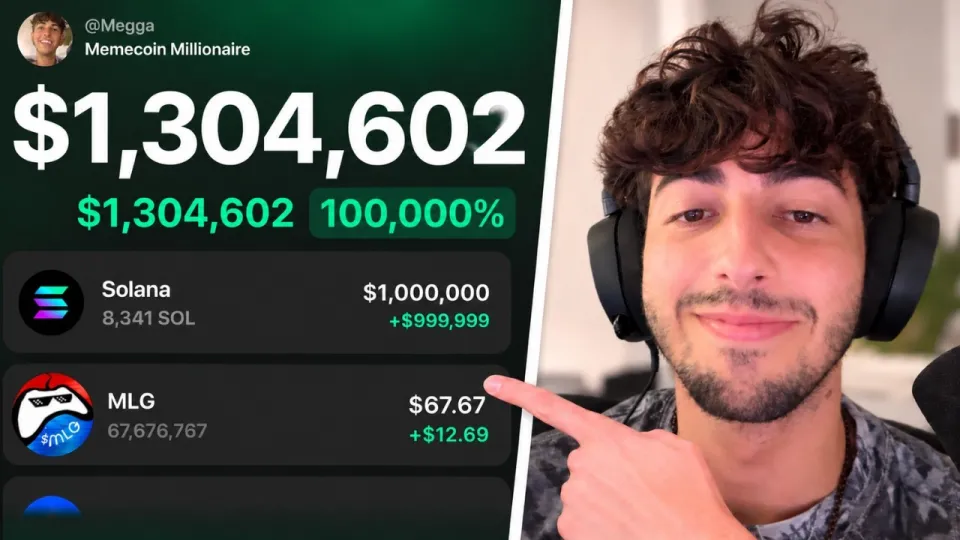
How meme coin trading turned a $1,000,000 run into a repeatable process for Megga
Want articles like this for your own video to promote it on YouTube and Google? Order them through the Telegram bot @sat_sit_bot. It writes articles around your video, embeds the video and publishes them on popular niche websites (no ads). Try it free: 50 articles on us.
· based on the channel Megga
Meme coin trading is the practice of buying and selling tokens with no cash flow, no product and no fundamental valuation, where price is driven almost entirely by attention, liquidity and timing. Megga's breakdown of a $1,000,000 result is built on exactly that premise: the edge is not in picking the "best" project but in processing hundreds of launches, sizing positions so a rug cannot end the account, and staying in the game long enough for the fat tail to arrive. The free course linked in the video is available here: free meme coin trading course on Whop.
What a $1,000,000 meme coin result actually consists of
A seven-figure PnL in memecoins is a distribution, not a single trade. The realistic shape of such a run is a long sequence of small losses, a large number of scratches at break-even, and a handful of positions that return 5x to 50x and carry the entire year. That is why the arithmetic matters more than the narrative: if 60% of trades lose an average of 20% of their size, and 5% of trades return 10x, the portfolio is still profitable — but only if position sizing keeps the losing streak survivable.
Three numbers define the model:
- Hit rate — most launches fail, so the majority of entries are expected to be wrong. The skill is cutting them fast.
- Payoff asymmetry — the winners must be allowed to run into multiples, which means not taking 30% profits on a token that could do 20x.
- Survival — no single position, and no single wallet, can be allowed to hold more than a small fraction of total capital, because rug pulls and wallet drains are routine rather than exceptional.
Anyone quoting a headline profit without those three parameters is selling a fantasy. The million is the output; the inputs are hundreds of hours of screening and a risk framework that never puts the account in a position to be wiped out.
Inside the trenches where meme coin launches are found
The "trenches" is the term traders use for the earliest, messiest stage of a token's life: a fresh contract, a thin pool, a Telegram or X account with a few hundred followers, and a chart that has existed for minutes. This is where the asymmetric returns live, and it is also where most money is lost. Working this environment means building a repeatable scanning routine rather than chasing whatever is trending on a timeline.
A practical routine looks like this:
- Filter by contract and liquidity, not by logo. Check whether the pool is locked or burned, how much of supply the deployer holds, and whether trading is enabled without a hidden tax.
- Watch wallet behaviour. Track which addresses bought the first blocks and whether they are still holding, adding, or distributing into strength. A cluster of known profitable wallets entering early is a stronger signal than any influencer post.
- Read the community as data. Speed of organic replies, quality of memes, whether the same twenty accounts are recycling the same message — all of it is information about whether attention is real or manufactured.
- Size before you enter, not after. Decide the maximum loss on the position while the chart is still unfamiliar, then buy only what fits that number.
Why 9 to 12 hours a day is the real strategy
Sustained screen time is the least glamorous and most decisive variable in meme coin trading. A trader who scans launches for nine to twelve hours a day sees thousands of contracts a month; someone who checks in after work sees a curated, already-pumped selection and buys the exit liquidity. The advantage is not intelligence, it is sample size and reaction speed.
That said, hours alone are not a strategy — a viewer's question about what actually fills those hours is the right one. Productive time splits roughly into four buckets: scanning new pairs and their on-chain history; monitoring open positions and pre-defined exit levels; reviewing the day's trades against the original thesis; and studying how previous runners behaved in their first hours so the pattern is recognisable next time. Twelve hours of scrolling without a written log produces experience without skill. Twelve hours with screenshots, entry reasoning and post-mortems produces a repeatable edge.
For anyone with a job, the honest answer is that the full-time version of this is not available. A part-time approach has to be narrower: fewer setups, higher conviction, smaller size, and a hard rule against entering positions that cannot be monitored during the session.
Risk, rugs and the losses nobody posts about
The memecoin market is adversarial by design, and the two failure modes that end accounts are rug pulls and wallet compromise. A rug is a token where the deployer or an early insider removes liquidity or dumps a hidden supply; a drain is a phishing approval that empties a wallet in one transaction. Both are common enough that any plan which assumes they will not happen is not a plan.
The countermeasures are boring and effective:
- Separate wallets. A hot wallet for active trades, holding only what is meant to be at risk, and a cold wallet for accumulated profit.
- Revoke approvals regularly and never sign a transaction from a link received in a direct message.
- Assume every new token is a rug until contract, liquidity and holder distribution say otherwise.
- Cap position size so that a total loss on any single token is a rounding error on the month, not a setback that changes behaviour.
- Stop after a defined drawdown. Emotional revenge trading after a bad day is where small losses become account-ending ones.
A recurring theme among traders who recover from a drain or a string of losses is that the recovery starts with going back to basics: smaller size, fewer tokens, stricter checks. The psychology matters as much as the checklist, because the market will test patience far more often than it rewards conviction.
Common questions from traders starting out in meme coins
Newer traders tend to ask the same handful of things, and the answers are less exciting than the questions. On how much capital is needed to trade alongside more experienced groups: there is no threshold that makes someone a good counterpart, but a track record of a few tens of thousands in all-time PnL is generally where people stop treating you as a beginner, and networking through X, streams and group chats is how most traders find their circle in the first place.
On how to tell whether a technical narrative or "meta" will actually work — the recurring question of whether a new theme will repeat the run of a previous one — the answer is that intuition is built from studying how earlier runners behaved in their first hours: who bought, how fast liquidity grew, how the community formed. There is no shortcut that lets someone enter at a $30,000 market cap without having watched dozens of failures at the same stage.
On drawdowns: they are part of the process, not evidence that the process is broken. The traders who last are the ones who set goals around consistency and execution quality rather than around a monthly profit target, and who treat money as a byproduct of a repeatable routine. And on the accusation that profits in this market come from someone else's loss — that is structurally true of every zero-sum market, which is precisely why position sizing and liquidity awareness matter more here than in any other asset class.
Useful links
- Free meme coin trading course on Whop
- Padre trading platform (low fees)
- Megga on Twitch
- Megga on TikTok
- Megga on X
The takeaway from Megga's meme coin breakdown
A $1,000,000 result in memecoins is a story about volume of attempts, disciplined sizing and time at the screen, not about a secret token. The replicable parts are the routine — scanning, checking contracts and holders, logging every trade — and the risk rules that keep an account alive through rugs, drains and losing streaks. The non-replicable part is the tolerance for spending most of a day in the trenches watching charts that mostly go to zero. Megga's full breakdown is worth watching as a case study in how that trade-off is actually made, and the free course on Whop is the starting point the channel points to for anyone who wants to test the process with small size first.
Key takeaways
- Megga's breakdown covers a $1,000,000 profit result from trading memecoins, built on consistency rather than one lucky trade.
- The strategy is centred on early-stage tokens in the "trenches" — low-cap launches where liquidity and attention are thin.
- Screen time of 9 to 12 hours a day is described as the core input: scanning launches, tracking wallets, reading community chatter.
- Losses and drawdowns are treated as part of the process; the video's comment section is full of traders recovering from rugs and phishing drains.
- A free course is offered via Whop, and the trading platform promoted is Padre, chosen for low fees.
Source: How I Made $1,000,000 Trading Memecoins (FULL BREAKDOWN) · Markdown version
Questions & answers
How much capital do you need to start trading meme coins seriously?
There is no fixed minimum, but the practical constraint is position sizing: a single loss should be small enough that it does not change your behaviour. Traders with a few tens of thousands in all-time PnL are usually treated as experienced enough to join group chats and share ideas, but the more important threshold is having a written risk rule you actually follow.
How do you tell whether a new meme coin narrative or meta will actually run?
You study how previous runners behaved in their first hours — who bought the earliest blocks, how fast liquidity grew, whether the community formed organically. There is no shortcut to entering at a $30,000 market cap without having watched dozens of tokens fail at exactly that stage, so the intuition comes from logged observation rather than from a single indicator.
Is it possible to trade meme coins while working a full-time job?
Yes, but not with the same approach as a full-time trader. Part-time means fewer setups, higher conviction, smaller size and a hard rule against entering positions you cannot monitor during the session. The nine-to-twelve-hour scanning routine is not available, so selectivity replaces volume.
Why do so many traders lose money even after a big win?
Because a large win often leads to larger size and looser checks, and the market punishes both. Rug pulls, phishing approvals that drain wallets, and revenge trading after a drawdown are the usual causes. Separating wallets, revoking approvals and capping position size are what keep a good run from being given back.